
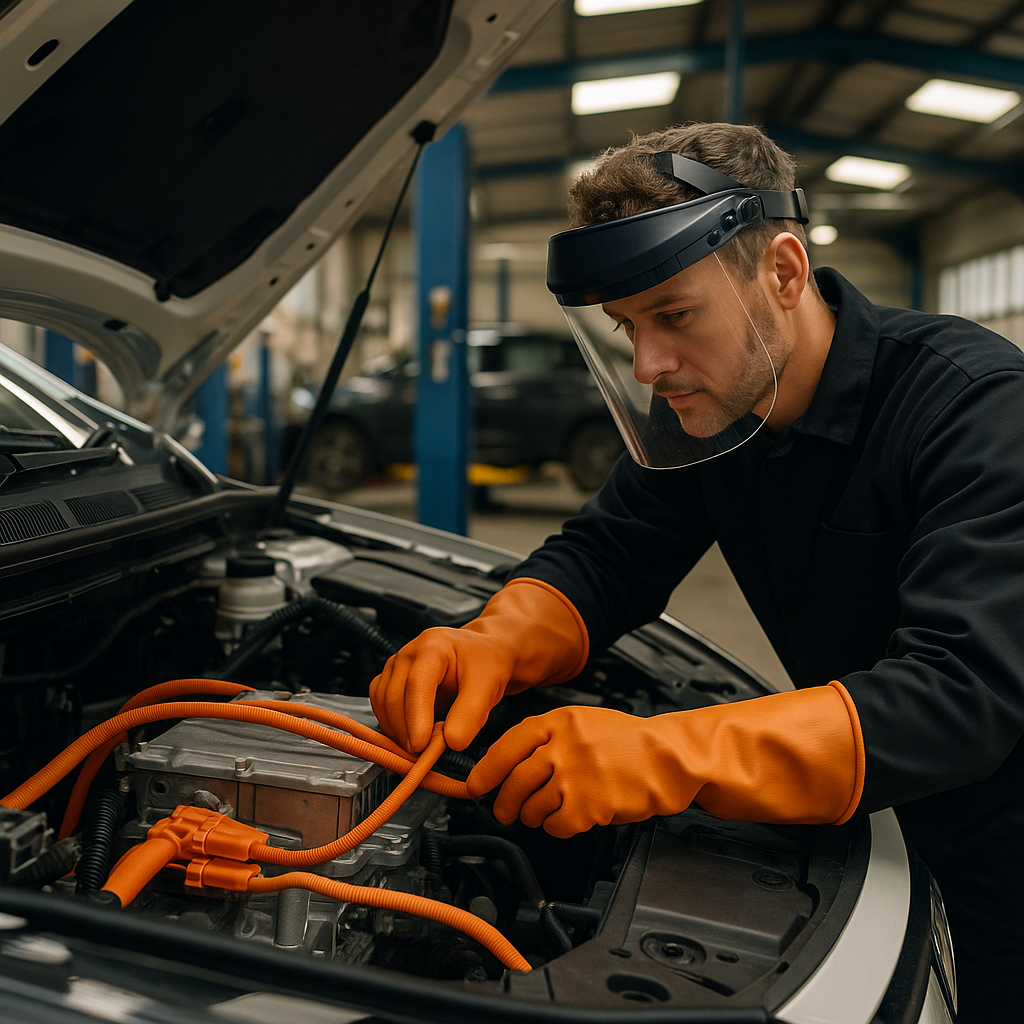
Electric and hybrid vehicles are no longer a niche corner of the workshop. They are arriving on ramps across the country in serious numbers, and that shift brings with it a set of risks that a good many mechanics have simply never had to think about before. Working around EV high voltage safety is not a matter of reading a quick leaflet and cracking on. The systems inside these vehicles can carry anywhere from 400V to 800V DC, and unlike the 240V AC supply coming out of your workshop wall, there is no zero-crossing point where the current briefly drops. At those levels, contact is likely fatal. That demands a fundamentally different approach before you even lift the bonnet.
Understanding What You Are Actually Dealing With
The high-voltage system in a modern EV or plug-in hybrid is essentially a separate electrical architecture sitting alongside the familiar 12V network. The traction battery pack, inverter, motor, onboard charger, and the cables connecting them all operate at voltages that are categorised under BSEN 60900 as Hazardous Live. Orange cables are the universal indicator. If you see orange anywhere under the bonnet or beneath the vehicle, treat it as live until you have gone through a full isolation procedure and confirmed otherwise with a calibrated meter.
Beyond the voltage, DC systems present a particular arc-flash hazard. An arc generated from a DC source does not self-extinguish the way an AC arc does. It will sustain itself until either the circuit is broken or the conductor is destroyed. That matters enormously in terms of what PPE you select and how you approach any work near exposed terminals.
Legal Obligations UK Mechanics Must Understand
Before touching any EV drivetrain component, it is worth being clear on where the law sits. The Health and Safety Executive (HSE) covers electrical work under the Electricity at Work Regulations 1989, which place a duty on both employers and employees to ensure that work on electrical systems is carried out safely and, where required, by competent persons. “Competent” in this context means trained and assessed for the specific voltage class of the work being done.
The Institute of the Motor Industry (IMI) provides the recognised accreditation pathway in the UK, with its EV/Hybrid Technician qualifications split across three levels depending on the scope of work. Level 1 covers routine servicing with no high-voltage exposure. Level 2 allows work adjacent to the HV system with isolation in place. Level 3 covers work on the HV system itself, including battery diagnostics and replacement. Workshops that allow unqualified technicians to work on live HV systems are exposed to serious liability under both HSE regulations and their motor trade insurance policy. Most insurers will not cover an incident if the technician involved lacked the appropriate IMI accreditation.
EV High Voltage Safety: The Isolation Procedure Step by Step
Isolation is the single most important procedural step before any HV-adjacent work begins. The general sequence looks like this, though always cross-reference the vehicle-specific workshop manual since manufacturers do vary:
- Switch the vehicle off and remove the key or key fob from the vehicle entirely. Many EVs will re-energise systems if the key remains nearby.
- Disconnect and remove the 12V auxiliary battery. This kills the control systems that can re-engage the HV contactors.
- Locate the manual service disconnect (MSD) or high-voltage interlock. On most vehicles this is accessible from beneath a seat or in the boot area. Remove it and place it in your pocket or a locked cabinet, not on the bench nearby.
- Wait the manufacturer-specified discharge time. This is critical. Capacitors within the inverter can retain lethal charge even after isolation. Fifteen minutes is a common minimum, but some systems specify longer.
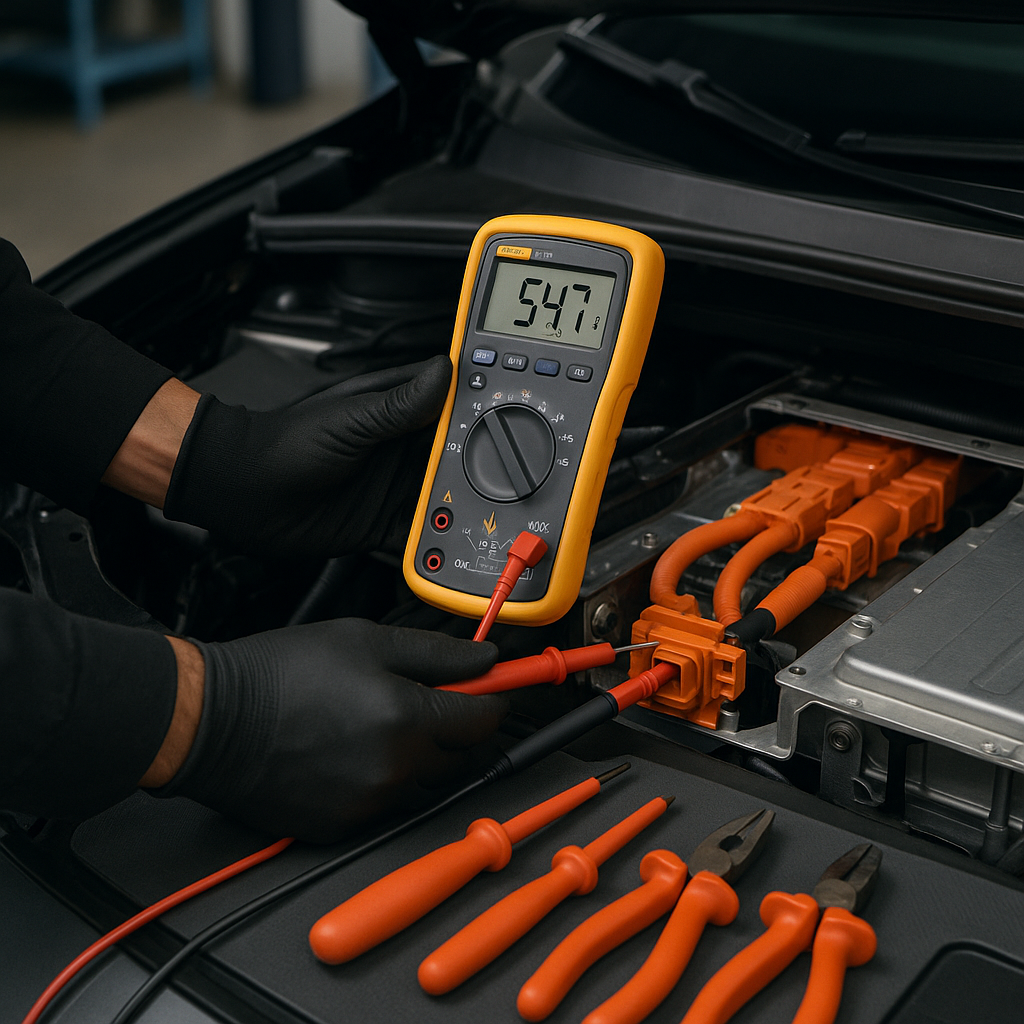
- Confirm dead using a calibrated CAT III or CAT IV rated multimeter before touching any HV component. Test, confirm, test again.
PPE Requirements for HV Workshop Work
Standard workshop gloves are not going to cut it here. PPE for EV high voltage safety work needs to be rated appropriately for the voltage class you are working in. The requirements for Class 1 insulating gloves (rated to 7,500V AC / 11,250V DC) are the minimum for most EV HV work. These must be:
- Inspected before every use for cuts, punctures, or degradation
- Stored correctly (away from sunlight, chemicals, and sharp objects)
- Tested to IEC 60903 standards and replaced within their service interval
Alongside the gloves, you need insulated overshoes or rubber-soled safety footwear, a face shield rated for arc flash rather than just impact, and insulated tools rated to at least 1,000V AC. Using standard screwdrivers or spanners near exposed HV terminals is one of the most common causes of serious workshop incidents on EVs. Every tool in contact with or near an HV component needs its VDE rating clearly marked on the handle.
It is also worth thinking about what you are wearing underneath all of this. Synthetic fabrics can melt to skin in an arc-flash event. Natural fibres are far preferable for anyone working regularly in the HV environment.
Workshop Setup and Environmental Considerations
EV high voltage safety does not stop at personal protection. The workshop environment itself needs to be set up correctly. Key points include:
Signage and access control. Any vehicle undergoing HV work should be clearly marked with approved hazard signs, and other technicians should know not to approach or move the vehicle. A simple procedure, but one that gets skipped constantly in busy workshops.
Thermal event preparedness. A compromised traction battery can enter thermal runaway, a process that is self-sustaining, extremely difficult to extinguish, and can re-ignite hours or even days later. Workshops handling EVs should have a thermal event protocol in place, including a designated external area where a burning vehicle can be moved safely. Some fire services now recommend submerging an EV battery fire in a large container of water. Worth a conversation with your local fire service before you need it.
Dedicated HV equipment storage. Insulating gloves, mats, and tools should be stored separately from general workshop equipment, clearly labelled, and checked on a scheduled basis.
None of this means workshops that primarily handle conventional vehicles need to overhaul everything overnight. If your bread and butter is still traditional ICE work, servicing tyres, brakes and suspension on an EV, or sourcing parts for older four-wheel-drive models (there are excellent specialist suppliers for things like Toyota 4×4 spares if that is your market), then the procedural overhead is manageable. But the moment an EV or hybrid comes in for anything drivetrain-related, the HV framework applies.
Keeping Up as the Technology Evolves
One of the practical frustrations with EV high voltage safety is that the technology is moving faster than the training infrastructure. Battery voltages are climbing. Some newer platforms, including several arriving in UK showrooms through 2025 and 2026, operate at 800V rather than the 400V that was the norm just a few years ago. Inverter designs are changing. Solid-state batteries are on the horizon. What was accurate training two years ago may not cover everything relevant today.
The IMI updates its qualification units periodically, and there are a growing number of manufacturer-authorised training programmes through networks like Bosch, Delphi, and the major franchise groups. Keeping a training log is not just good practice; it is the kind of documented evidence that protects you and your employer if an incident ever occurs and someone starts asking what competency was in place on the day.
The honest summary is this: EV high voltage safety is not intimidating once you understand it systematically, but it absolutely requires respect, the right PPE, proper isolation, and verifiable training. Skipping any one of those is not a calculated risk, it is an unacceptable one.
Frequently Asked Questions
Do I need a specific qualification to work on electric vehicles in the UK?
Yes. The IMI (Institute of the Motor Industry) provides the recognised EV/Hybrid Technician qualification in the UK, covering three levels depending on the scope of work. Employers have a legal duty under the Electricity at Work Regulations 1989 to ensure anyone working on or near high-voltage systems is competent, which in practice means holding the appropriate IMI accreditation.
What voltage do EV traction batteries typically operate at?
Most current EVs and plug-in hybrids operate at between 400V and 800V DC. Some newer platforms launching in 2025 and 2026 are moving to 800V architecture for faster charging. Both voltage levels are classified as Hazardous Live and require full isolation procedures and rated PPE before any work begins.
What PPE do I need for EV high voltage safety work?
At a minimum you need Class 1 insulating gloves rated to IEC 60903 standards, rubber-soled insulating footwear, an arc-flash rated face shield, and insulated VDE-rated tools (minimum 1,000V AC). Standard workshop gloves and tools are not acceptable for HV work and their use near live terminals is a serious safety risk.
How long should I wait after isolating an EV before touching HV components?
Always follow the vehicle manufacturer’s specified discharge time. Fifteen minutes is a common minimum, but some systems require longer due to capacitor discharge times within the inverter. After waiting, you must still confirm the system is dead using a calibrated CAT III or CAT IV multimeter before touching any HV component.
What should a workshop do if an EV battery goes into thermal runaway?
Have an established thermal event protocol in place before it happens. This should include a designated external area to move the vehicle safely, communication with your local fire service regarding their recommended suppression approach, and awareness that a battery fire can re-ignite hours or days after appearing extinguished. Do not attempt to fight a traction battery fire with a standard workshop extinguisher.