
Something is changing on the ramps across UK garages, and it has nothing to do with oil changes or exhaust repairs. More electric vehicles are rolling in with suspension problems than most mechanics expected at this stage of the EV rollout. The weight of battery packs, combined with the way instant torque loads components on acceleration and braking, is accelerating wear patterns that would typically take years longer to appear on a comparable petrol car. EV suspension wear is quickly becoming one of the more pressing topics any UK mechanic working in 2026 needs to understand.
This is not a niche concern. The number of EVs on UK roads has grown substantially, and many of the earlier models, Nissan Leafs, first-generation Renault Zoes, Tesla Model 3s sold in 2019 and 2020, are now accumulating genuine mileage. Those vehicles are past their honeymoon period. And what garages are finding underneath them is instructive.
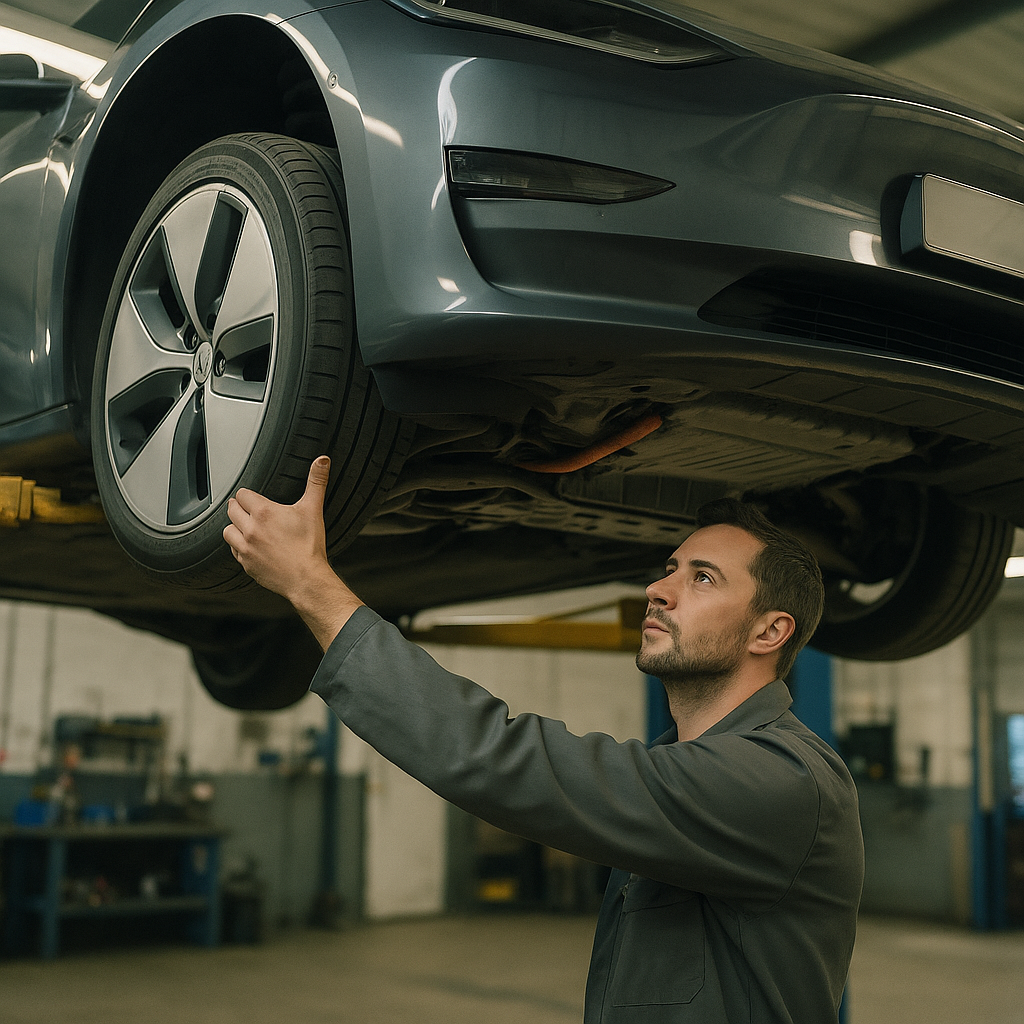
Why EVs Are Harder on Suspension Than You Might Expect
The physics are fairly straightforward once you think them through. A typical family-sized EV weighs somewhere between 300 kg and 600 kg more than its petrol equivalent, almost all of it sitting low in the chassis as a battery pack. That extra mass has to go somewhere when the car corners, brakes, or hits a pothole. It goes straight into the suspension components.
Add instant torque into the equation and the picture gets more interesting. When a petrol engine builds power through a rev range, torque loads on the drivetrain and suspension build progressively. An electric motor delivers maximum torque from zero RPM. Every sharp pull away from traffic lights, every motorway merge, every spirited exit from a roundabout loads the front wishbones, rear subframe bushes, and wheel bearings with forces that traditional suspension geometry was rarely engineered to absorb quite so abruptly. Over tens of thousands of miles, that adds up.
Which Components Are Failing First
Garages with a growing EV customer base are reporting a fairly consistent pattern of early failures. Ball joints and wishbone bushes are coming in worn far sooner than expected, particularly on front-wheel-drive EVs where the motor is driving and steering the same axle. The combination of lateral cornering loads, longitudinal torque, and increased static weight is punishing to rubber-bonded components.
Wheel bearings are another consistent finding. The extra mass increases the radial load on hub bearings constantly, and because EV drivers often use regenerative braking rather than the friction brakes, the bearing is doing more work managing deceleration forces rather than sharing them with brake components. Tesla Model 3 rear wheel bearings, in particular, have developed a reputation in the independent garage world for needing attention earlier than the mileage would suggest on a petrol car.
Anti-roll bar drop links and the associated bushes are also appearing on job sheets with increasing regularity. On vehicles like the Kia e-Niro and Hyundai Ioniq 5, the stiffened suspension tuning used to manage roll on a heavy platform puts sustained stress on these smaller components. They are cheap to buy but easy to overlook unless you are specifically checking for them.
Shock absorbers are worth mentioning separately. On EVs with air suspension or adaptive dampers, think Mercedes EQS or the higher-spec Polestar 2, the dampers themselves are working harder to manage body roll from the higher kerb weight. Several independent workshops are reporting premature damper fade on vehicles with fewer than 60,000 miles.
Diagnostic Pointers That Are Easy to Miss
One of the subtler challenges for an EV suspension wear UK mechanic is that these vehicles are quieter. A knocking ball joint or a worn bush that would have been obvious through the cabin noise on a petrol car can be masked by the near-silence of an electric drivetrain. Customers often present with vague complaints about handling or a slight pull, rather than the classic clunk-on-a-speed-bump that flags a problem immediately.
A thorough visual inspection on the ramp, with the car loaded to simulate normal operating weight where possible, catches far more than a quick shake of the wheel. Road test before and after any work is essential. Checking tyre wear patterns is also a reliable shortcut: uneven wear on EV tyres is often the first visible sign that something in the suspension geometry has drifted, frequently caused by a worn bush or ball joint that has allowed camber to shift.
It is worth noting that the Driver and Vehicle Standards Agency (DVSA) MOT guidance covers EV suspension checks under the same framework as conventional vehicles, so MOT testers are already looking at these components. The opportunity for garages lies in catching wear before it becomes an MOT failure, building a reputation as the workshop that actually understands EVs rather than just plugging in a charger and sending them on their way.
How Garages Are Turning This Into a Revenue Stream
The smart garages are not waiting for EV suspension problems to walk through the door. They are actively marketing suspension health checks as part of an EV service package, especially targeting vehicles over three years old or past 40,000 miles. Given that suspension work on EVs is broadly the same labour process as on any other car (once you account for safe high-voltage working procedures where relevant), the margin is decent and the parts costs are familiar.
Building a stock of commonly needed components helps. Wishbone bush kits for the Nissan Leaf, wheel bearing assemblies for the Tesla Model 3, anti-roll bar link kits for the Kia e-Niro: these are the kind of items that once sat on the shelf for petrol equivalents and are now worth keeping on hand for EV work. Several factors make this practical in 2026 compared to even two years ago: OEM and pattern parts availability for popular EVs has genuinely improved, and the number of vehicles needing them has reached a point where it is economically sensible to hold stock.
Some workshops are also offering alignment checks as a natural upsell after any suspension work, which makes complete sense given how sensitive EV handling is to geometry changes under load. A four-wheel alignment on a car that has had a pair of wishbone bushes replaced is not optional at this weight class; it is necessary.
Getting Staff Up to Speed
Suspension work on EVs does not require specialist EV training in the way that battery or motor work does, provided the components being replaced are below the high-voltage system. However, any technician working near the battery housing or underfloor should be familiar with basic high-voltage awareness procedures. The Institute of the Motor Industry (IMI) EV awareness qualifications cover this ground and are worth having in place before the workshop takes on more EV work across the board.
The bigger knowledge gap is often on parts identification and compatibility. EV variants of popular platforms sometimes use different suspension specifications to the equivalent petrol or diesel model, and ordering the wrong bush or bearing because the vehicle identification was not checked against the EV-specific parts catalogue is a frustrating and avoidable mistake. Getting technicians comfortable with EV-specific parts lookup is a quick win.
The volume of EV suspension work coming through UK workshops is only going to increase as the fleet ages. Garages that build the knowledge and the parts relationships now are positioning themselves ahead of a wave that is already gathering pace.
Frequently Asked Questions
Do electric vehicles wear out suspension components faster than petrol cars?
Yes, in most cases. EVs are significantly heavier due to their battery packs, and instant torque delivery loads suspension components more abruptly than a conventional engine. Ball joints, wishbone bushes, and wheel bearings are commonly showing accelerated wear on high-mileage EVs.
Which EVs are UK mechanics seeing the most suspension problems on?
Early Nissan Leafs, first-generation Tesla Model 3s, and Kia e-Niros are among the vehicles appearing most frequently with suspension wear in independent UK garages in 2026. These are models that have been on UK roads long enough to accumulate significant mileage and are now past their initial warranty coverage for many owners.
Is EV suspension work different from regular suspension repairs?
The mechanical work is largely the same, but technicians need to be aware of the vehicle’s high-voltage system when working in proximity to the battery housing. For most suspension components, bushes, ball joints, drop links, bearings, the repair process is familiar, though EV-specific parts catalogues should always be checked for correct fitment.