
The shift toward electrified vehicles on UK roads is no longer a distant prospect, it’s the daily reality in most workshops. Whether you’re booking in a Toyota Yaris Cross hybrid or a Nissan Leaf that’s clocked 80,000 miles, the servicing picture looks very different from what a traditional petrol or diesel job demands. Hybrid and EV servicing shares some common ground, but the differences matter enormously, both for safety and for getting the job right. Here’s what you actually need to know.

Why Hybrid and EV Servicing Are Not the Same Thing
It’s tempting to lump hybrids and full EVs together under the banner of electrified vehicles, but that’s a bit like saying a diesel van and a petrol sports car are basically the same because neither is electric. A mild hybrid (MHEV) still relies predominantly on its internal combustion engine. A full hybrid (HEV) like the Prius can drive short distances on electric alone. A plug-in hybrid (PHEV) has a meaningfully sized battery pack and can travel 30-50 miles on electric in real-world conditions. A battery electric vehicle (BEV) has none of the combustion side at all.
Each of those brings a different set of maintenance demands. The overlap with traditional servicing decreases as you move up that list, and the high-voltage considerations increase. Get comfortable with where each type sits before you start quoting service intervals or ordering parts.
Brake System Differences: Regenerative Braking Changes Everything
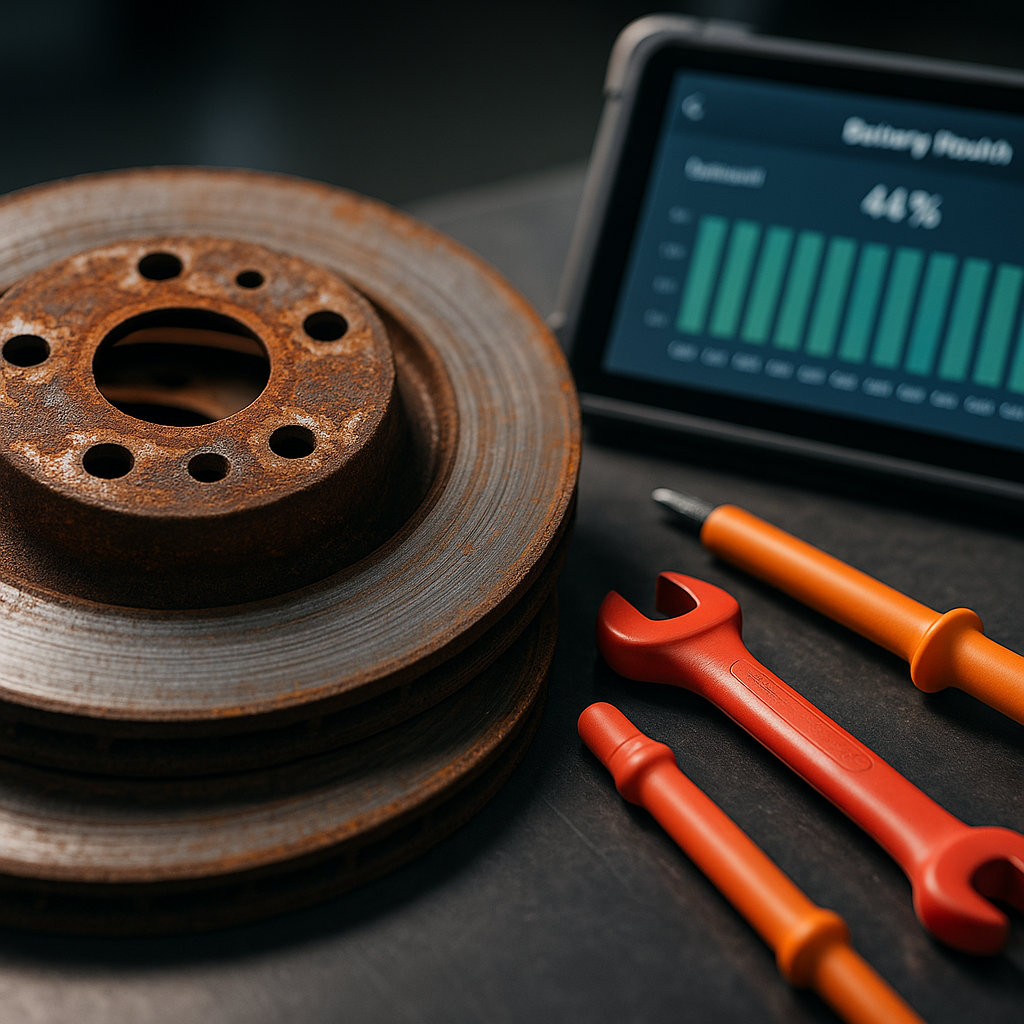
This is where most mechanics get their first real surprise. On a conventional vehicle, brake pads and discs wear predictably with mileage. On a full EV or a PHEV doing a lot of electric miles, regenerative braking handles the majority of the deceleration. The friction brakes barely touch the rotors during normal driving. The result? Corrosion, not wear, is the enemy. Discs on a Nissan Leaf or a Tesla Model 3 can look absolutely shocking after 30,000 miles despite having plenty of material left, because surface rust builds up from infrequent use.
The practical implication for hybrid and EV servicing is that you need to assess disc condition differently. Scoring from rust seizing, not just pad wear indicators, should drive your replacement recommendations. Some manufacturers specify brake fluid changes on a time basis (typically two years) regardless of condition, because the callipers and master cylinders on hybrid systems often work harder than the discs do. Check the vehicle-specific schedule rather than assuming the conventional rule applies.
On regenerative braking systems, the brake pedal feel and response are managed by a brake-by-wire or blended braking system. If a customer complains of a pulsing, grabbing, or unusual pedal feel, don’t assume it’s a straightforward pad or disc issue. It may be a software calibration fault or a problem with the regenerative blending strategy. Diagnostic interrogation is step one.
Fluids: What Stays, What Changes, What Disappears
Full EVs obviously have no engine oil, no coolant for an internal combustion engine, and no transmission fluid in the conventional sense. But that doesn’t mean they’re fluid-free. Most BEVs use a dedicated thermal management system for the battery pack, the inverter, and the electric motor, and those systems contain coolant that has its own service life. It’s dielectric (non-conductive) in many cases, and substituting the wrong product is a serious mistake.
On hybrids, you still have conventional engine oil and coolant to deal with, but interval recommendations often differ from the equivalent petrol-only platform. Some Toyota hybrids specify longer oil change intervals because the engine runs less frequently and under lower average load. Others stick to annual changes regardless. Don’t assume, check the OEM schedule.
Brake fluid on both hybrid and EV platforms is hygroscopic, just as on conventional vehicles, so the two-year replacement recommendation remains sound. On PHEVs with e-axle differentials, there may be a separate gear oil to check. Gearbox fluid on some hybrid automatic units (particularly CVT variants) also has a specific spec that differs from off-the-shelf ATF. Using the wrong fluid here can damage the transmission.
High-Voltage Safety: This Is Not Optional
Any vehicle with a high-voltage system, typically anything operating above 60V DC or 25V AC, which covers virtually all hybrids and EVs, requires a fundamentally different approach to safe working. The Institution of Engineering and Technology (IET) and the IMI both publish guidance on this. The IMI’s Level 3 Award in Electric/Hybrid Vehicle System Repair and Replacement is the benchmark qualification for working on HV systems in a professional UK workshop context.
Before working near the HV system, the vehicle must be isolated. This means switching to service mode or removing the service disconnect plug or manually discharging the system, depending on the platform. On a Toyota Prius, that’s a relatively well-documented procedure. On some newer BEVs, the process is less intuitive and varies by model year. Always obtain the vehicle-specific workshop manual before you start.
Personal protective equipment for HV work is non-negotiable. Class 0 insulating gloves rated to 1,000V AC minimum, insulating mats, and properly insulated tools are the baseline. Mechanics who work regularly on track-day or motorsport-adjacent machines will already be familiar with the importance of specialist safety gear, similar discipline applies here. Just as drivers heading to a circuit need properly certified racing suits before they get anywhere near the grid, technicians working on HV systems need the right PPE before they touch anything orange-cabled.
Never assume the system is de-energised because the ignition is off. HV capacitors in the inverter can hold a lethal charge for several minutes after shutdown. The IMI guidance and the UK government’s EV infrastructure resources both reinforce the importance of formal training before working on these systems unsupervised.
Common Fault Patterns Mechanics Are Seeing in the UK
Beyond the planned servicing, there are fault patterns showing up with increasing regularity as hybrid and electric vehicles age in the UK fleet. On older Toyota hybrids (pre-2016 Prius generations in particular), the 12V auxiliary battery is a frequent failure point. The main hybrid battery tends to get all the attention, but it’s the humble 12V that leaves customers stranded. It often fails without much warning and is frequently overlooked at service.
On Nissan Leafs, battery degradation is the headline concern. First-generation 24kWh packs have often lost 20-30% of their original capacity by the time they reach a decade of age. Customers need honest conversation about real-world range, and workshops offering battery health checks have a genuine value-add service to sell. Diagnostic tools like LEAF Spy (for customers) and OEM-level tools give you the State of Health reading you need.
On PHEVs, particularly the Mitsubishi Outlander PHEV and the BMW 3 Series PHEV variants, the cooling system for the HV battery pack can develop issues around the pump and associated hoses. These are often missed because they don’t trigger obvious warning lamps until the fault is well established. On any PHEV service, it’s worth checking coolant levels in the battery thermal loop, not just the engine circuit.
Tooling and Equipment You Actually Need
A generic OBD2 reader will not cut it for serious hybrid and EV servicing. Manufacturer-specific diagnostic software or a capable third-party tool with hybrid and EV coverage is essential. Autel, Launch, and Snap-on all offer units with reasonable coverage across the major platforms. For Toyota and Lexus hybrids, Techstream remains the gold standard. For VAG group PHEVs, ODIS is the proper tool.
Beyond diagnostics, insulated tooling, a proper isolation kit, and a multimeter rated for HV work are the key additions over a conventional workshop setup. The upfront investment isn’t trivial, but the customer base is there and growing. According to the Society of Motor Manufacturers and Traders (SMMT), over 1.1 million plug-in vehicles were registered in the UK by the end of 2025. That’s a lot of work coming through workshop doors.
The Bottom Line for UK Workshops
Hybrid and EV servicing isn’t a niche specialism any more, it’s mainstream. The workshops that have invested in training and tooling are already seeing the benefit. Those that haven’t are turning away work or, worse, attempting jobs without the right competence. The technical knowledge required is genuinely different from conventional servicing, but it’s entirely learnable. Start with the IMI qualification, get the right PPE, and build your platform-specific knowledge one model at a time. The hybrid and EV workload isn’t going to slow down.
Frequently Asked Questions
Do electric vehicles need servicing as often as petrol cars?
Full EVs generally have fewer service items than petrol vehicles, no oil changes, no spark plugs, no exhaust system. However, they still require brake fluid changes typically every two years, tyre rotations, cabin filter replacements, and checks on the HV battery cooling system. Annual health checks are recommended even if the mileage is low.
Can any mechanic work on a hybrid or EV high-voltage system?
Not safely without proper training. In the UK, the IMI Level 3 Award in Electric/Hybrid Vehicle System Repair and Replacement is the recognised qualification for working on high-voltage systems. Attempting HV work without this training puts the technician at serious risk of electrocution, as battery packs operate at 300-800V in many modern vehicles.
Why do EV brake discs corrode so quickly despite low mileage?
Regenerative braking handles most deceleration on full EVs and PHEVs doing lots of electric miles, so the friction brakes are used infrequently. Without regular heat and friction to clean the disc surface, moisture causes surface rust to build up rapidly. This can cause judder, sticking callipers, and reduced braking performance even when plenty of disc material remains.
What coolant should I use in an electric vehicle battery cooling system?
Always use the manufacturer-specified coolant for the HV battery thermal management circuit. Many EVs require a dielectric (non-conductive) coolant that is chemically distinct from conventional engine antifreeze. Using the wrong product can damage the cooling system components and, in worst cases, create a conductivity risk in a high-voltage environment.
How do I check the health of an older Nissan Leaf battery?
The most reliable method in a workshop environment is using a diagnostic tool with Nissan CAN bus access to read the State of Health (SoH) value from the battery management system. Apps like LEAF Spy (used with an OBD2 Bluetooth adaptor) give customers access to the same data. A first-generation Leaf with an SoH below 70-75% is typically showing noticeable real-world range reduction.