
The home EV charging market in the UK is growing faster than most people in the trade expected. According to gov.uk, there are now well over a million registered electric vehicles on UK roads, and a significant proportion of those owners are either installing home charge points for the first time or dealing with faults on existing units. For a skilled auto electrician, this is genuinely one of the most lucrative openings the trade has seen in years. The question is how to position yourself to take full advantage of it.
This guide covers exactly that. Certifications, tools, pricing, and the practical realities of turning EV charging repair into a proper income stream.
Why EV Charging Repair Is a Smart Move for Auto Electricians Right Now
Traditional auto electrical work is evolving rapidly. Alternators, starter motors, and traditional wiring looms are increasingly being supplemented by high-voltage systems, CAN bus diagnostics, and battery management electronics. Home charge point installation and repair sits right at the intersection of automotive knowledge and domestic electrical understanding, which makes auto electricians arguably better placed than either purely domestic electricians or general mechanics to handle this work.
Faults are common. Charge points from brands like Pod Point, Ohme, Hypervolt, and Easee regularly throw connectivity errors, software glitches, earthing faults, and relay failures. Homeowners often find that the original installer has moved on or charges a call-out fee that rivals the cost of a new unit. A local, knowledgeable auto electrician who understands both the vehicle side and the installation side is genuinely rare, and clients will pay well for that.
What Certifications Do You Actually Need?
This is where a lot of auto electricians stall, and it is worth being direct about what is and is not required.
To install or work on domestic charge points as a business, you need to be registered with a competent person scheme. For EV charging specifically, the relevant scheme is NAPIT or NICEIC, with OZEV (Office for Zero Emission Vehicles) approval being the key accreditation for accessing the government’s EV chargepoint grant scheme. Without OZEV approval, you cannot install charge points that qualify for the grant, which immediately limits your market.
The typical route is:
- City and Guilds 2919 (Electric Vehicle Charging Equipment Installation) or equivalent EV-specific qualification. This is the recognised standard and takes between three and five days depending on the provider.
- 18th Edition Wiring Regulations (BS 7671) if you do not already hold it. Most experienced auto electricians are familiar with 12V and 24V vehicle systems but may not hold the domestic wiring qualification. This is a short course and genuinely essential.
- OZEV Approved Installer registration through a body such as NAPIT or NICEIC. There is a cost involved, typically in the region of £300 to £600 per year depending on the scheme, but it opens up the grant-eligible installation market.
For repair work rather than new installations, the rules are slightly less prescriptive, but being registered and qualified still gives customers confidence and protects you professionally.
Tools You Will Need for EV Charging Repair Work
The good news is that an auto electrician already owns a lot of what is needed. The additions are not hugely expensive.
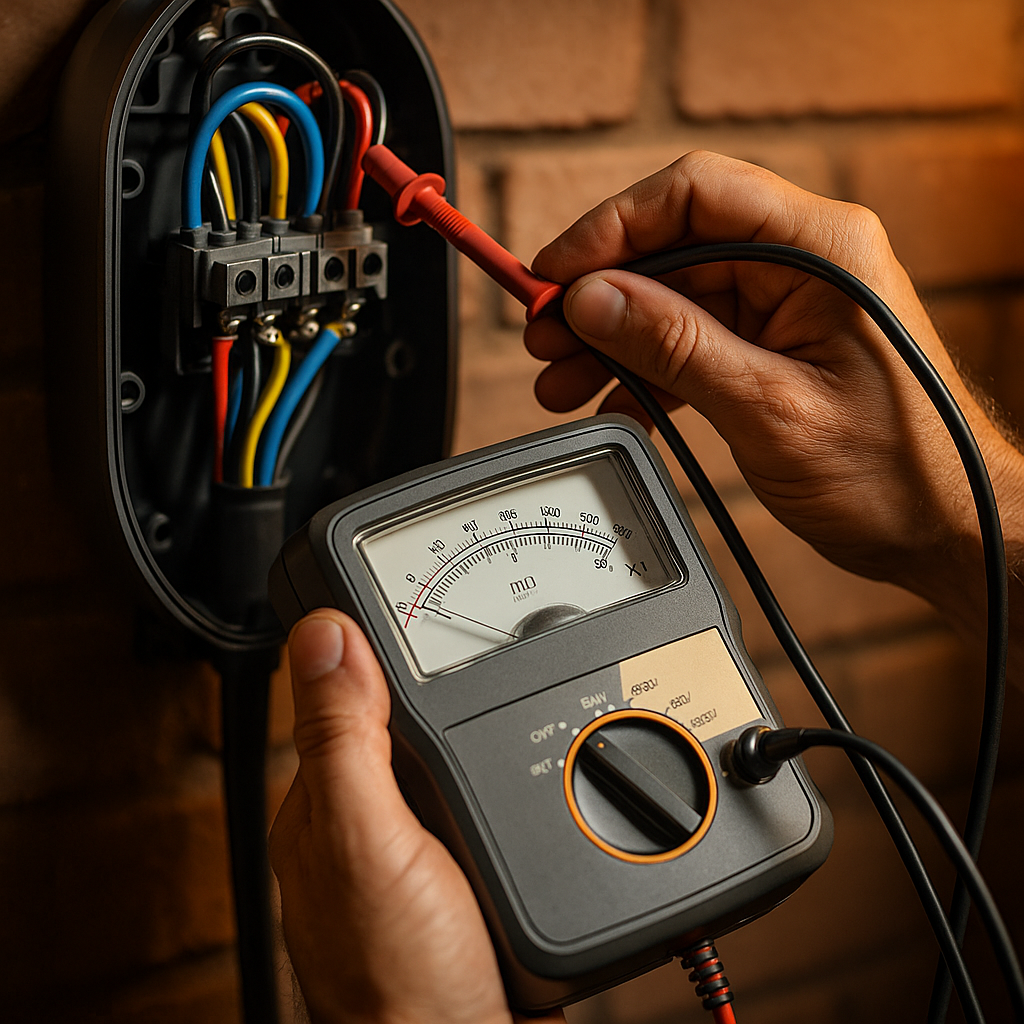
Insulation resistance tester (MFT). A multifunction tester capable of insulation resistance, continuity, and loop impedance testing is essential for domestic charge point work. Megger and Fluke both produce reliable units used widely across the UK trade. Expect to spend between £300 and £700 for a quality instrument.
EV-rated PPE. High-voltage gloves rated to at least Category 0 (1000V), insulated screwdrivers, and voltage testers. These should already be part of any auto electrician’s kit if they are working on HV vehicle systems.
Laptop or tablet with charge point diagnostic software. Most modern charge points from major brands have companion apps or web-based back-end portals that allow configuration and fault code reading. Familiarity with OCPP (Open Charge Point Protocol) basics helps when dealing with smart charger issues.
Cable crimping and termination kit. Home charge point installations typically terminate in a consumer unit or dedicated RCBO-protected circuit. Clean, properly torqued terminations are non-negotiable.
Beyond these additions, the oscilloscope, multimeters, and wiring knowledge already in your kit translate directly.
How to Price EV Charging Repair Jobs Competitively
Pricing is where many skilled tradespeople undervalue themselves, particularly when entering a new service area. Here is a realistic breakdown based on current UK market rates.
New home charge point installation: The total cost including equipment typically runs from £900 to £1,400 for a standard 7kW single-phase unit. Labour for a straightforward install is generally priced between £250 and £450. Faster installation means lower unit cost; complicated cable runs, consumer unit upgrades, or listed buildings push it higher. The OZEV grant currently offers £350 off for eligible properties, which makes your approved installer status a genuine sales point.
Fault diagnosis and repair: Call-out plus first hour is typically £80 to £120, with subsequent hours at £50 to £80. Most common charge point faults, connectivity resets, relay replacements, earthing corrections, are resolved within two hours on-site. A straightforward relay swap in a Pod Point unit that takes 90 minutes should comfortably bill at £180 to £200 including parts.
Software reconfiguration and pairing issues: Smart charger pairing failures with home Wi-Fi or a vehicle’s RFID system are increasingly common and often take less than an hour to resolve. Pricing this at a flat £95 to £120 call-out feels fair and keeps customers coming back rather than calling a manufacturer’s expensive helpline.
The key to competitive pricing in this space is not racing to the bottom. EV owners are, on average, higher earners with relatively new vehicles. They expect professional service and will pay for it. Price accordingly.
Building a Customer Base in the EV Charging Space
Word of mouth travels quickly among EV owners, particularly in local Facebook groups and neighbourhood apps like Nextdoor. One well-handled job tends to generate two or three referrals. Make sure you leave every installation tidy, provide a brief handover explaining the charge point operation, and follow up with a WhatsApp or email check-in a fortnight later. It sounds simple, but most tradespeople do not do it.
Registering as an OZEV-approved installer and listing on relevant trade directories (Trustmark, NAPIT’s public finder) builds organic enquiries without paid advertising. Partnering with local EV dealerships, particularly independent ones, creates a referral pipeline that can fill your diary surprisingly quickly.
The EV charging repair and installation market is still relatively uncrowded with genuinely skilled auto electricians. The work suits the trade perfectly, the certification route is manageable, and the earnings potential is real. For any auto electrician looking at where the next five years of solid work is coming from, this is worth taking seriously.
Frequently Asked Questions
Do I need special certification to repair EV home charging units as an auto electrician?
For fault diagnosis and repair work, there is no single mandatory certification, but holding City and Guilds 2919 and 18th Edition BS 7671 qualifications is strongly advisable and builds client confidence. If you want to install new units and access the OZEV government grant scheme, you will need to register as an approved installer through NAPIT or NICEIC.
How much can an auto electrician charge for EV charger repair in the UK?
A typical call-out and first hour of diagnostic work runs between £80 and £120, with most common faults resolved within two hours. Straightforward repairs such as relay replacements or earthing corrections generally bill out at £150 to £220 including parts, depending on your location and the complexity of the job.
What is the OZEV approved installer scheme and do I need it?
OZEV (Office for Zero Emission Vehicles) approved installer status allows you to install charge points that qualify for the government’s EV chargepoint grant, currently worth £350 for eligible properties. Without it, you can still carry out repair work but you cannot offer grant-eligible installations, which significantly limits your market.
What are the most common faults auto electricians find on home EV chargers?
The most frequent issues include Wi-Fi or Ethernet connectivity failures, faulty RCBO or relay components, earthing faults caused by poor original installations, and software or firmware glitches that prevent charging sessions from starting. Most of these are within the skill set of an experienced auto electrician with basic domestic wiring knowledge.
How long does it take to qualify for EV charging installation work?
The City and Guilds 2919 course typically runs between three and five days, and the 18th Edition Wiring Regulations course can be completed in around three to four days if you do not already hold it. Registration with an approved installer scheme such as NAPIT or NICEIC then takes a few weeks to process, so the total route from start to trading is realistically six to ten weeks.