

Most independent garages should take on grey import EV repairs, but only after they have set rules for what they will and won’t touch. The cars are arriving whether you want them or not: Chinese brands without a full UK network, and parallel imports from Japan and Europe. The garages that cope best treat each one as a research job first and a repair second. Here are the points that matter.
1. Know what the car actually is in law
A parallel import that already has UK type approval, or one that has been through Individual Vehicle Approval (IVA) and registered with the DVLA, is a legal road vehicle. Your first check is the V5C and the registration route. The government’s guidance on importing vehicles into the UK explains the approval routes. If the paperwork is shaky, you are being asked to maintain a car that may not be legal to use, and that is a conversation to have at the front desk, not after the ramp booking.
2. Check what your duty of care covers
The Consumer Rights Act 2015 requires services to be carried out with reasonable care and skill, and that applies to a grey import exactly as it does to a Ford Focus. The lack of manufacturer data does not lower the standard. What it changes is how you protect yourself: record the vehicle’s condition on arrival, write down what you could and could not verify, and get the customer to sign off on any work where no torque figure or procedure was available.
3. Be honest about high-voltage competence
Anyone working on the high-voltage system needs proper training, typically an IMI or equivalent EV qualification, plus the right insulated tools and a safe working procedure. A grey import does not make this optional. In practice, many garages decide to do the low-voltage work (brakes, suspension, tyres, 12V electrics, air conditioning that is not high-voltage) and refer battery and drive unit faults elsewhere. That is a sound business decision, not a failure.
4. Build a diagnostic workaround kit
Proprietary diagnostic systems are the biggest wall. A few approaches work in practice:
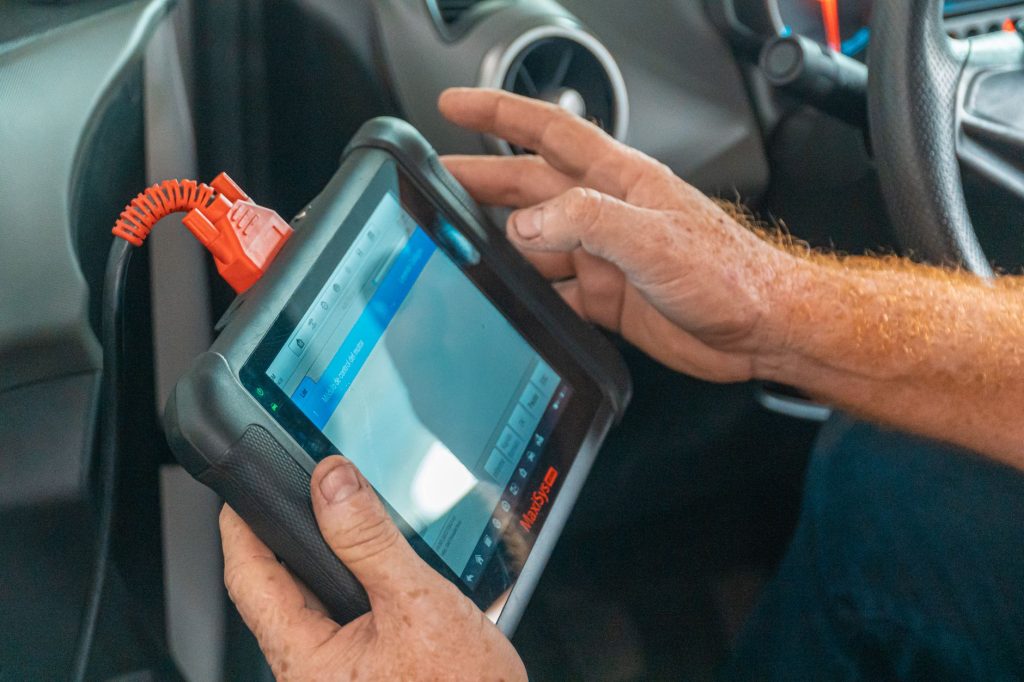
- A good multi-brand scan tool will often read generic OBD-II data, even where it cannot reach the manufacturer’s deeper modules.
- Some Chinese manufacturers sell their diagnostic software and interface to independents through export channels. Ask the importer or the manufacturer’s overseas support before buying aftermarket clones.
- A good oscilloscope and breakout leads let you test sensors and CAN signals when the software cannot.
- Keep a log of every car you see: part numbers, fault codes, what fixed it. By your fifth car of one model, you know more than most of the internet.
Software-led faults are common on these cars. Our piece on how AI vehicle diagnostics is changing the way garages identify faults covers where pattern-matching tools help and where they guess.
5. How do you source parts for a grey import EV?
For a grey import EV, parts usually come from one of three routes: the importer or distributor, an overseas supplier shipped to you, or a UK breaker with the same model. Expect weeks for anything specific to the car, and have the customer agree that timeline in writing before you order. Our guide to sourcing strategies for the parts delay crisis sets out the supplier options in more detail.
Japanese imports are the easiest category here. If the car is a Mitsubishi, a specialist breaker is often quicker than air freight for trim, switchgear and body parts, and Mitzybitz.com is worth a look before you place an overseas order. Mechanical and battery parts still need to be matched to the exact model and market, because specifications differ between Japanese-market and UK-market cars.
Say a customer’s imported hatchback needs a rear wishbone and the only listed supplier quotes five weeks. Don’t just accept it. Check whether the part is shared with another model, ask a breaker, and have the customer decide whether to wait or to take the car home on a safe temporary fix. If it affects braking or steering, never offer the temporary fix.
6. Price the job when information is thin
Pricing is where garages lose money on these cars. Published labour times do not exist, so quote on time and not on a fixed price. A workable approach:
- Charge a separate diagnostic or investigation fee, agreed upfront, because research time is real labour.
- Give a fixed price only for jobs you have already done on the same model.
- On first-time jobs, quote an hourly rate with an estimate range and a cap that needs the customer’s approval to exceed.
- Mark up parts to cover sourcing time and the risk of wrong deliveries, and state any return restrictions on overseas parts.
- Keep a note of how long each job really took, so the second quote is sharper than the first.
Customers with these cars usually know the support is thin. What they resent is surprises. A quote that says what you know, what you don’t and what happens if the job runs over keeps the relationship intact.
7. Decide your policy before the first car arrives
Write a one-page policy: which makes you will accept, which systems you will work on, what paperwork you need, and what you refer out. It stops you taking on a risky job because the customer is standing at the counter. Garages that do this tend to find these cars become a steady sideline rather than a headache. If you do take them, make the first one a simple job such as brakes or a service, learn the car, and build outwards.
One last practical step: join an owners’ group or forum for each model you see. The owners often know the workarounds before any workshop does, and the part numbers they share can save you days.
Frequently Asked Questions
Can an independent garage legally repair a grey import EV?
Yes, provided the car is registered and road legal in the UK. Garages must still work with reasonable care and skill under the Consumer Rights Act 2015. High-voltage work needs properly trained technicians, regardless of where the car came from.
Do grey import EVs need IVA to be used in the UK?
A vehicle without existing UK or Great Britain type approval generally needs an approval route such as Individual Vehicle Approval before it can be registered with the DVLA. Check the gov.uk importing guidance for the current process and the V5C for the registration status.
How do garages diagnose an EV with no dealer software?
They combine a multi-brand scan tool for generic data, an oscilloscope for signal testing and any diagnostic software the manufacturer sells through export channels. Keeping a log of faults and fixes on each model also builds knowledge quickly.

Leave a Reply