
Battery technology is moving fast, and if you work in the motor trade or simply care about where cars are heading, solid-state batteries are the single most important development to get your head around. The shift from current lithium-ion packs to solid-state chemistry could change how EVs are built, how long they last, how quickly they charge, and critically, how they’re repaired. Getting solid state battery cars explained in plain terms is genuinely useful right now, even if mass-market production is still a few years off.
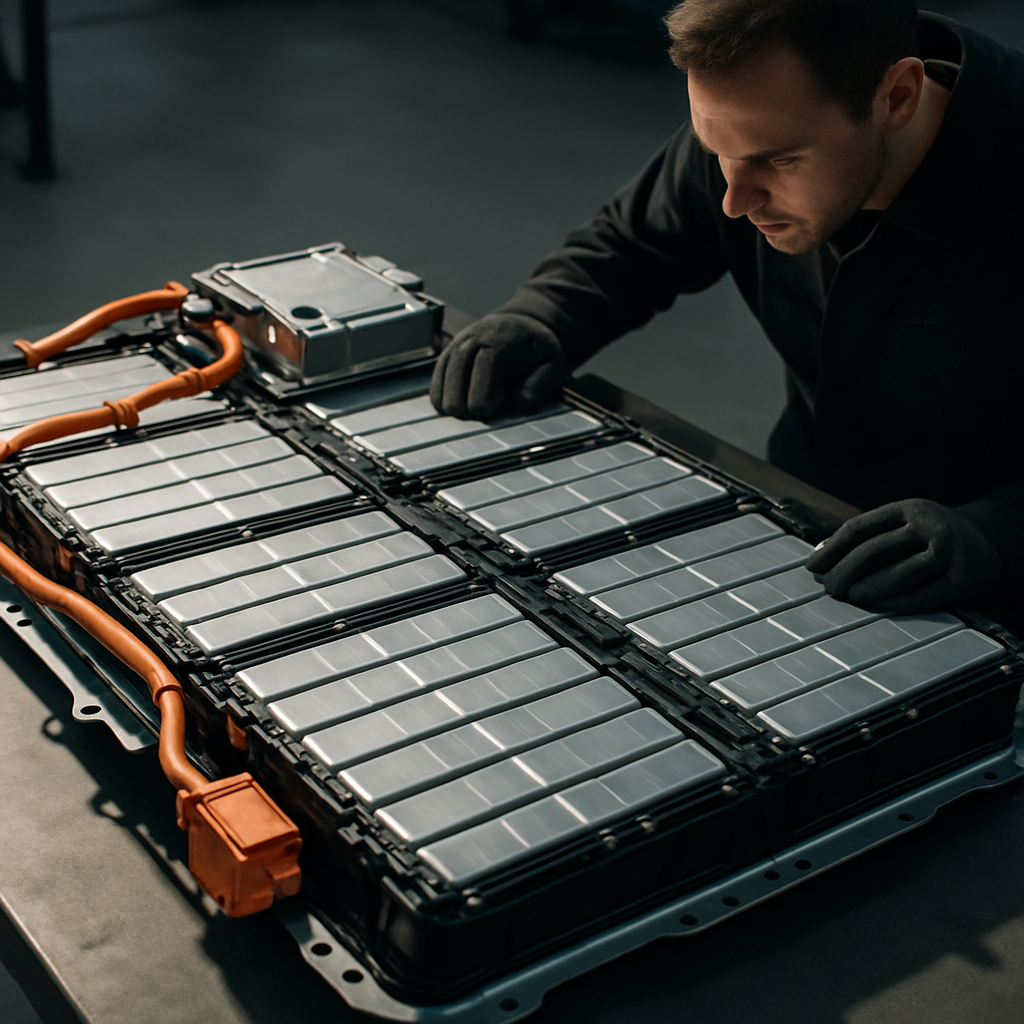
What Is a Solid-State Battery and How Does It Differ from Lithium-Ion?
Today’s EV battery packs use a liquid electrolyte to move lithium ions between the anode and cathode. It works, it’s proven, but it comes with serious drawbacks. Liquid electrolytes are flammable, they degrade over time, they limit how fast you can safely charge, and they require precise thermal management to stop them going into thermal runaway. Anyone who’s dealt with a damaged Tesla or Nissan Leaf pack knows what a thermal event looks like, and it’s not pleasant.
A solid-state battery swaps that liquid out for a solid electrolyte material, typically a ceramic, glass, or polymer compound. No flammable liquid means a fundamentally safer cell. The solid electrolyte is also more stable at higher temperatures and allows the use of a lithium-metal anode instead of graphite, which dramatically increases energy density. More energy in the same physical space. That translates to longer range, or a lighter, smaller pack that achieves the same range as a heavier lithium-ion unit today.
Charging speed improves too. Current lithium-ion packs need careful management to avoid lithium plating on the anode during fast charging, which degrades the battery. Solid-state chemistry is less susceptible to this, meaning genuinely rapid charging without the same long-term penalty to capacity.
The Main Technical Challenges Still Being Solved
If solid-state batteries are so much better, why aren’t they in your workshop already? Because manufacturing them at scale is brutally difficult. The interface between the solid electrolyte and the electrodes needs to be in near-perfect contact across the entire cell. Any gap, crack, or inconsistency and you lose conductivity. Solid materials also expand and contract with temperature and charge cycles, and managing that stress without the cell cracking is a serious engineering problem.
Cost is the other wall. Current production processes for solid-state cells are expensive. Scaling them up to the volumes needed for mass-market cars without a massive price premium hasn’t been cracked yet. Several manufacturers have prototype cells performing brilliantly in lab conditions. Getting those same results consistently off a production line is another matter entirely.

Which Manufacturers Are Closest to Production?
Toyota has been the most vocal about solid-state ambitions. The Japanese giant has held more solid-state battery patents than any other manufacturer and has confirmed its intention to launch a solid-state EV in the late 2020s. Their stated targets include a range of over 750 miles per charge and a ten-minute 0-80% charge time. Whether those figures translate fully to real-world production vehicles remains to be seen, but they’ve committed significant resources.
Nissan has partnered with NASA and announced plans for solid-state batteries in its EVs by 2028. Volkswagen, through its investment in QuantumScape (a Silicon Valley start-up working on solid-state cells), has been funding development seriously for years. BMW, Honda, and Stellantis all have active programmes. Samsung SDI and CATL, both massive battery suppliers to the European market, are working on semi-solid and solid-state formats that could feed into UK-spec vehicles.
Closer to home, Jaguar Land Rover’s parent company Tata has invested in Agratas, its battery manufacturing operation, and the UK government’s Faraday Institution has been funding solid-state research at British universities for several years. You can read more about those efforts at faraday.ac.uk, the Faraday Institution’s official site.
What Does This Mean for EV Servicing and Repair?
This is where it gets interesting for mechanics and auto electricians. Solid-state batteries aren’t simply a drop-in replacement for current packs. The service implications are significant and worth thinking about now.
On the positive side, solid-state batteries are expected to degrade more slowly. Fewer cell replacements, longer warranties, less battery reconditioning work. If a pack lasts 20 years without meaningful capacity loss, the secondary battery market looks very different. The thermal management systems could also be simpler, since the cells are inherently safer and operate across a wider temperature range. That potentially means less coolant pipework, simpler high-voltage cooling circuits, and fewer related failure points.
On the other hand, when something does go wrong, solid-state packs may be harder to repair at cell level. Current lithium-ion packs can sometimes have individual modules replaced by a trained technician. A solid-state pack with cracked electrolyte interfaces or electrode separation is a more complex problem to diagnose and fix. Manufacturers may lean harder into complete pack replacement rather than module-level repair, which pushes the work towards dealerships and specialist EV centres with the tooling to handle it.
Diagnostics will evolve too. The failure modes of solid-state cells are different from lithium-ion. Dendrite growth (where lithium deposits build up and can eventually pierce the solid electrolyte) is a known failure mechanism. OBD tooling and battery management system software will need to reflect these new failure signatures, and mechanics will need to understand what they’re looking at.
Should You Be Preparing for This Now?
The honest answer is: start building awareness, but don’t rip up your workshop yet. Solid state battery cars explained at a technical level will become increasingly relevant training material as the 2030s approach. The vehicles arriving in showrooms and workshops over the next two to three years will still be lithium-ion. But the pace of development suggests that by the time your apprentice completes their training today, solid-state vehicles will be a live servicing consideration.
Keeping up with manufacturer technical bulletins, following the Faraday Institution’s research outputs, and understanding the chemistry at a conceptual level puts you ahead of the curve. When the first solid-state-equipped vehicles start appearing for their first MOT or their first post-warranty check-up, you want to be the workshop that already knows the difference.
The fundamentals of high-voltage safety, battery management system diagnostics, and thermal system servicing all remain directly relevant. Solid-state technology is an evolution, not a complete reinvention of how you work. But the details matter, and the motor trade professionals who understand them will be the ones customers trust with an expensive piece of kit.
Frequently Asked Questions
What is a solid-state battery in simple terms?
A solid-state battery replaces the liquid electrolyte found in standard lithium-ion cells with a solid material, typically ceramic or glass. This makes the battery safer, more energy-dense, and capable of faster charging, though manufacturing them at scale remains a significant challenge.
When will solid-state battery cars be available in the UK?
Toyota has targeted the late 2020s for its first solid-state production vehicles, with Nissan aiming for around 2028. UK buyers are unlikely to see widespread availability until the early-to-mid 2030s, though limited releases could appear sooner from premium manufacturers.
Are solid-state batteries safer than lithium-ion?
Yes, significantly. Removing the flammable liquid electrolyte eliminates one of the main causes of thermal runaway in current EV packs. Solid-state cells are more thermally stable and less prone to the kind of fire risks associated with damaged lithium-ion batteries.
How will solid-state batteries affect EV servicing costs?
In the long run, slower degradation should mean fewer battery replacements and simpler thermal management systems to service. However, when solid-state packs do fail, cell-level repair is likely to be more complex, potentially pushing costs towards full pack replacement rather than module-level fixes.
Do mechanics need new qualifications to work on solid-state EV batteries?
Existing high-voltage EV qualifications remain the foundation, but additional training on solid-state failure modes and diagnostics will be needed as these vehicles enter the market. Keeping up with manufacturer technical training and organisations like the Faraday Institution will be important preparation.